Nails · guide
Gel, acrylic or polygel: which set is right for your hands?
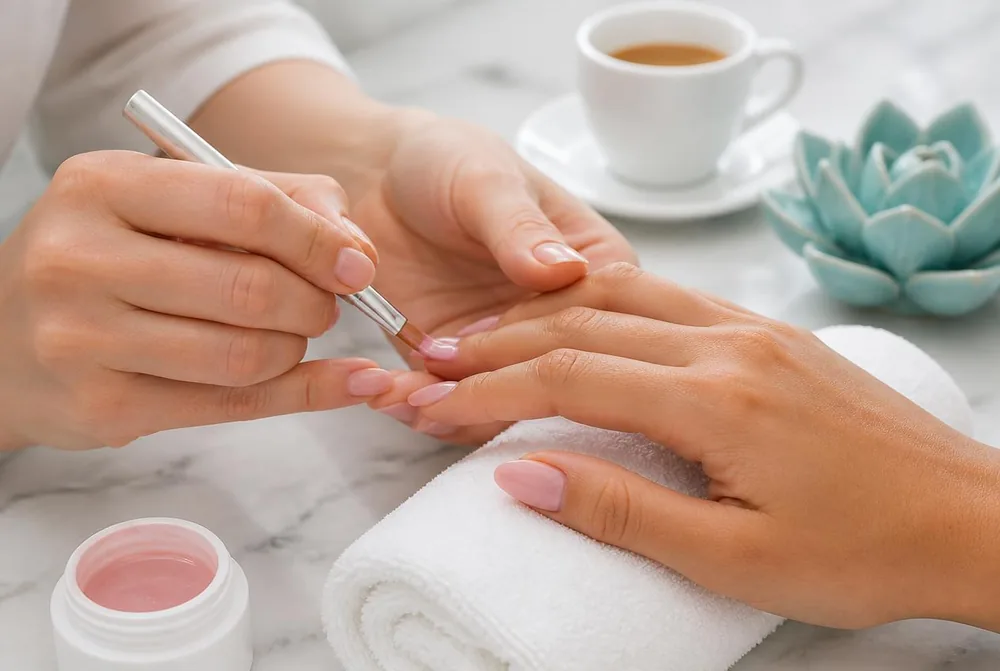
Sit down at May Art on a Saturday and you’ll hear the same three words in half the conversations: gel, acrylic, polygel — and, more quietly, rubber base. All four live on the same nail menu, all four end in polish, and all four feel completely different by the second day. Here is the plain version of what each one is, what it costs here, and how May actually decides which one goes on your hands.
What each one actually is
Gel manicure — $40
A gel manicure is color, full stop. Your natural nail gets shaped, the cuticles are cleaned up, and the polish on top is gel, cured under a lamp so it doesn’t smudge or chip in a day. There’s no extension, no added length, no building material. It’s the lightest option on the menu and the closest thing to “no product at all,” just with a shine that lasts weeks instead of days.
Rubber base — $55
Rubber base isn’t a color, it’s a base coat with a job: making a natural nail that peels, splits or bends less likely to do any of that. It goes on before your gel color, flexes with the nail instead of sitting rigid on top of it, and is the option May reaches for on clients who don’t want length but whose nails don’t hold up well on their own.
Acrylic full set — $65, 1 h 30
Acrylic is the classic. A liquid-and-powder mix is sculpted over a form or tip to build a hard extension in the shape and length you ask for — square, almond, coffin, stiletto. It’s been the industry standard for extensions for decades because it’s strong and holds sharp shapes well. It’s also the heaviest and most rigid of the four.
Polygel full set — $70, 1 h 30
Polygel is a newer builder gel, applied and shaped by hand before it’s cured under a lamp rather than air-dried like acrylic. The result is an extension that’s lighter and more flexible than acrylic, with a bit more give if it catches on something. It costs five dollars more than acrylic at May Art, mostly because the application is a little more hands-on.
Feel and weight on your hand
Ask ten clients and you’ll get ten opinions, but the general pattern holds: gel and rubber base feel like your own nail, just shinier and sturdier. Acrylic feels the most substantial — some clients love the weight, others take a day or two to stop noticing it. Polygel sits in between: you can tell there’s length there, but it flexes with your hand instead of resisting it.
How long each one lasts
None of these are permanent, and none should be treated as if they were. A gel manicure grows out with your nail and usually gets refreshed every 2–3 weeks. Rubber base behaves the same way. Acrylic and polygel extensions need a refill on that same 2–3 week rhythm — not because the product fails, but because your natural nail keeps growing underneath it, and the balance point shifts. Waiting past 4 weeks doesn’t make the set last longer; it just makes the next refill more work (and pricier — see our refill guide for the breakdown).
Taking it off is not optional
This is the rule May repeats the most: acrylic and polygel come off with a proper soak-off, not with your fingers. Peeling or picking an extension off takes layers of your natural nail with it, and that’s the damage that actually takes months to grow back, not weeks. Acrylic removal at May Art is $17, done carefully with acetone and a cuticle-safe technique that protects what’s underneath. If you’re switching from acrylic to gel, or just done with extensions for a while, book the removal — don’t do it in your car.
| Set | Best for | Feel | At May Art |
|---|---|---|---|
| Gel manicure | Natural nails, low maintenance, no extension | Light, like your own nail | $40 · 45 min |
| Rubber base | Natural nails that peel or bend | Light, flexible, strengthened | $55 · 50 min |
| Acrylic full set | Length + a hard, classic finish | Solid, the most substantial | $65 · 1 h 30 |
| Polygel full set | Length with less weight | Sturdy but flexible | $70 · 1 h 30 |
How May decides at the table
Ask May which one is “best” and she’ll ask to see your hands first. Someone who types all day and bites their cuticles gets a different recommendation than someone headed to a wedding who wants length for two weeks. She looks at how thin or flexible your natural nail already is, how you use your hands day to day, and how much length you’re asking for — then talks you through the trade-offs before anything goes on.
Not sure what you want? Book any nail service on Booksy and mention it in the notes — May will check your nails at the table and adjust before starting, no extra charge for switching between gel, rubber base or a full set.
More from the table
The 2–3 week rule: when to refill (and why it saves you money)
Why refills cost more the longer you wait, how to spot lifting early, and what to do between visits.
Read
A Dominican blowout in Florida humidity: how to make it last all week
What the blower actually does, the night routine that keeps it sleek, and when to add keratin.
Read